Seville
You can be here in March for about €1,111, 4 days, 1 stop.
Why now
Prime time in March: 20°C days.
Spring is the season, with the Semana Santa processions and the Feria a fortnight apart, both of which need rooms booked months ahead; autumn is nearly as good with none of that pressure. In July and August the city runs at over 40 degrees and afternoons are for shutters.
Best months here: April, May, November. March is not one of them — the label above measures the month against a fixed bar, not against the rest of the year here. Daytime highs, sea temperature and rainy days from three years of Open-Meteo reanalysis; a rainy day is one with at least 1 mm of rain, which is the WMO threshold and not the same as "it drizzled".
The place
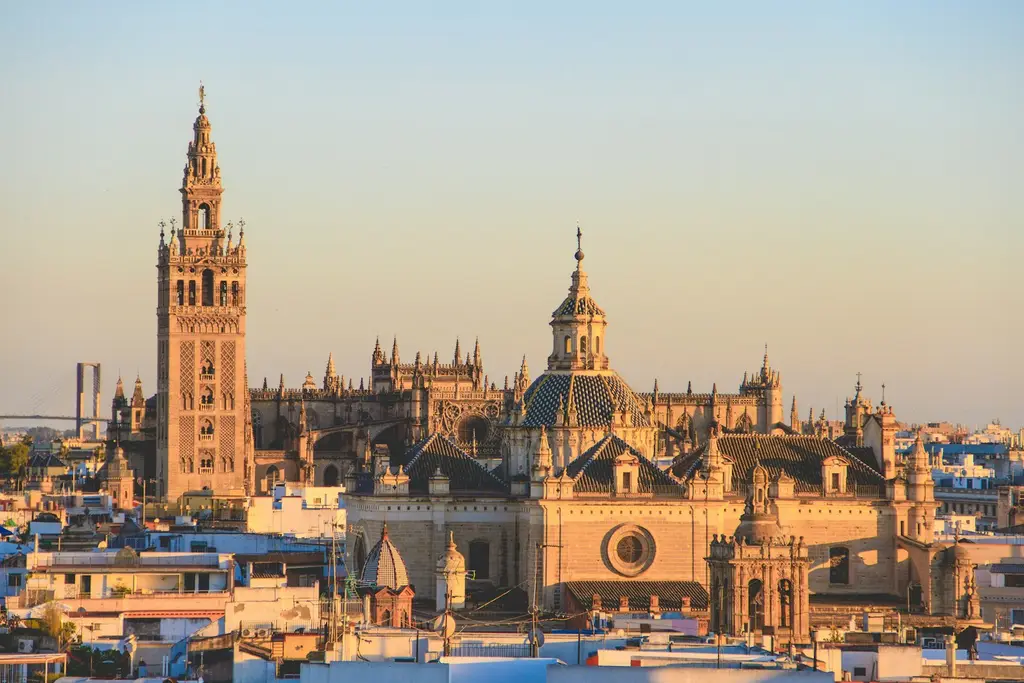
Seville is the Andalusian capital of orange trees, tiled patios and a river that made it rich once, with a Moorish palace still used by the king and a cathedral built, by the chapter's own account, to make later generations think them mad. It suits people who like heat, late nights and flamenco in small rooms; it is hard work in July and a different city in April.
What you can do
- 01Book the Real Alcázar for the first slot and walk its gardens before the heat; the palace itself is a Mudéjar textbook.
- 02Climb the Giralda's ramps for the view, then find the Murillos and the vast gilded altarpiece in the cathedral below.
- 03Eat tapas standing at bars in Triana or the Alameda: spinach with chickpeas, salmorejo, solomillo al whisky.
- 04See flamenco in a small venue such as the Casa de la Memoria or a Triana peña rather than a dinner show.
- 05Walk the Parque de María Luisa to the Plaza de España, and another day the Museo de Bellas Artes for Zurbarán.
Where to stay · neighbourhoods
Stay in Santa Cruz or El Arenal for a first visit, Triana or the Alameda for the evenings; during Semana Santa and the Feria, book the year before.
Unusual things
- ◦The Casa de Pilatos, a sixteenth-century palace mixing Mudéjar tiles, Renaissance courtyards and Roman statues, rarely crowded.
- ◦The Antiquarium under the Metropol Parasol, Roman mosaics and fish-sauce factories beneath the wooden structure.
- ◦The Itálica ruins at Santiponce, birthplace of Trajan, with a large amphitheatre and mosaics, a bus ride from the centre.
Day trips
Flight options
Routes come from OpenFlights (historical) and a 2026 route reference compiled from public timetables. Durations are the published schedule where we have it, otherwise a block-time model fitted on measured nonstop flights. Verify schedules with the airline before booking.
Entry requirements · IT passport
Source: passport-index-data, March 2026 (coarse indicator), covering 258 of our 268 destinations for each of 199 passports. Always confirm with the destination's official site.
Airports
Distances are centre to airport derived · nonstop counts are our route reference for 2026, not every flight that exists.
Local transport
- Airport to city
- Bus EA, 35 min, €4
- Car needed?
- No — walkable or good public transport
- Getting around
- The centre is walkable and the single tram and metro line are of marginal use; bikes work on the flat riverside. The airport is about 35 minutes from the centre by the EA bus.
- Clock
- 5 hours ahead of Toronto (Europe/Madrid) derived
- Daylight
- 11.9 hours of daylight in March · sunrise 07:37, sunset 19:30 derived
- Currency
- EUR
Good to know
From June to September the afternoon heat regularly exceeds 40 degrees; plan sights for the morning and after seven.
Alternatives at a similar price
Whole trip per person for 4 days from Toronto in March, then the flight time; estimates, like the total above.
 Orlando
 Cairo
Cairo Las Vegas
 Dallas
 Santiago
 New Orleans