Dubrovnik
You can be here in July for about €996, 4 days, direct.
Why now
Prime time in July: 31°C days, dry, sea 27°C.
Late April to early June and October keep the walls walkable without queues, and the sea is warm from June; the city caps daily visitors but summer still fills the old town by mid-morning. Many restaurants inside the walls close from November to March.
Best months here: June, July, September. Daytime highs, sea temperature and rainy days from three years of Open-Meteo reanalysis; a rainy day is one with at least 1 mm of rain, which is the WMO threshold and not the same as "it drizzled".
The place
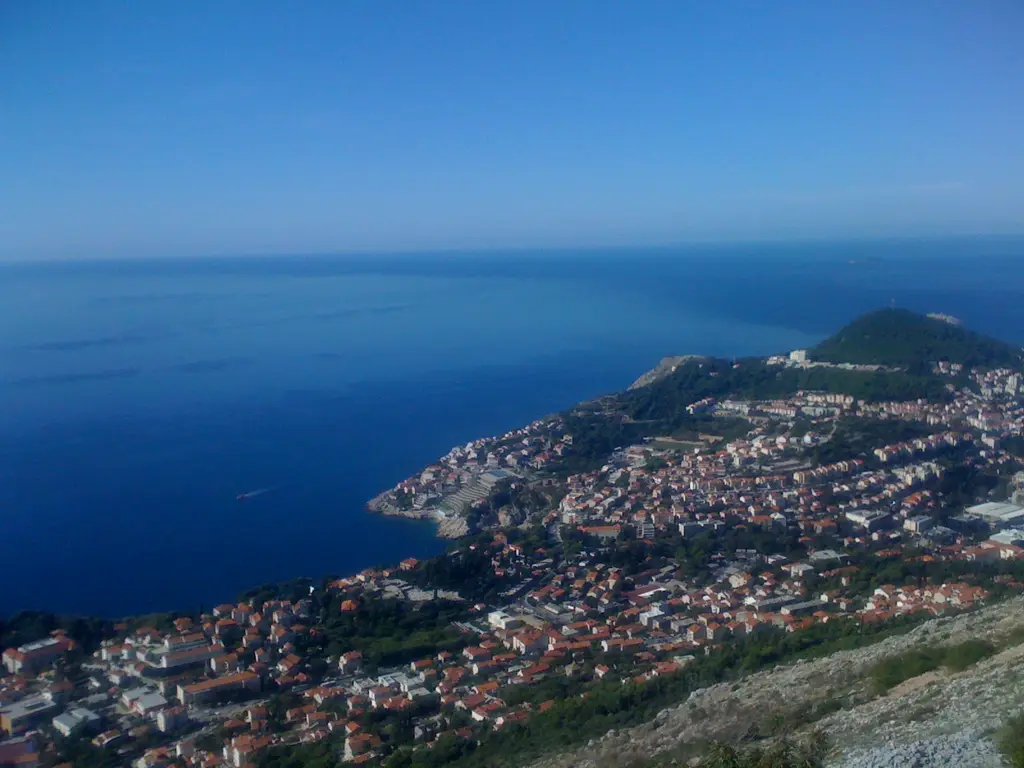
Dubrovnik is a walled Republic turned open-air set, and the tension is exactly that: the stone is real, the cisterns and monasteries are real, and by eleven in the morning the Stradun belongs to the cruise ships. It suits people willing to get up early, walk the walls at opening, and spend the middle of the day on a boat or a beach.
What you can do
- 01Walk the city walls at opening or the last hour before closing; the two-kilometre circuit takes about an hour.
- 02Swim at Buža, the bar on the rocks through a hole in the seaward wall.
- 03Take the boat to Lokrum for the monastery, the peacocks and the small salt lake.
- 04Ride the cable car up Srđ for the view, then walk down through the Napoleonic fort if the heat allows.
- 05Visit the Franciscan pharmacy, in business since 1317, and the Rector's Palace before the tour groups.
Where to stay · neighbourhoods
A first visit should stay in Ploče or Pile, walking distance from the gates without the old-town stairs and noise; Lapad suits families and anyone who wants a beach morning. Rooms inside the walls need a check on luggage access.
Unusual things
- ◦The Homeland War museum inside Fort Imperial on Srđ, telling the 1991 siege from the hilltop where it was fought.
- ◦Trsteno Arboretum, a Renaissance garden with a 500-year-old plane tree and aqueduct, 20 minutes north by bus.
- ◦Ston's medieval salt pans and the five-kilometre defensive wall, walkable in about an hour with an oyster lunch at Mali Ston.
Day trips
Flight options
Routes come from OpenFlights (historical) and a 2026 route reference compiled from public timetables. Durations are the published schedule where we have it, otherwise a block-time model fitted on measured nonstop flights. Verify schedules with the airline before booking.
Entry requirements · IT passport
Source: passport-index-data, March 2026 (coarse indicator), covering 258 of our 268 destinations for each of 199 passports. Always confirm with the destination's official site.
Airports
Distances are centre to airport derived · nonstop counts are our route reference for 2026, not every flight that exists.
Local transport
- Airport to city
- Shuttle, 30 min, €10
- Car needed?
- No — walkable or good public transport
- Getting around
- The airport bus meets flights and reaches Pile gate in about 30 minutes; city buses 1a, 1b and 6 link Gruž port, Lapad and Pile. The old town is walked, and taxis from Pile are the way to reach anywhere the buses skip.
- Clock
- Same time as Milan (Europe/Zagreb) derived
- Daylight
- 15 hours of daylight in July · sunrise 05:22, sunset 20:25 derived
- Currency
- EUR
Good to know
Cruise-ship days push the old town past comfortable capacity; check the port schedule and plan the walls and museums for early morning on those dates.
Alternatives at a similar price
Whole trip per person for 4 days from Milan in July, then the flight time; estimates, like the total above.
 Pantelleria
 Lampedusa
 Nice
Nice Menorca
 Madeira
 Santorini